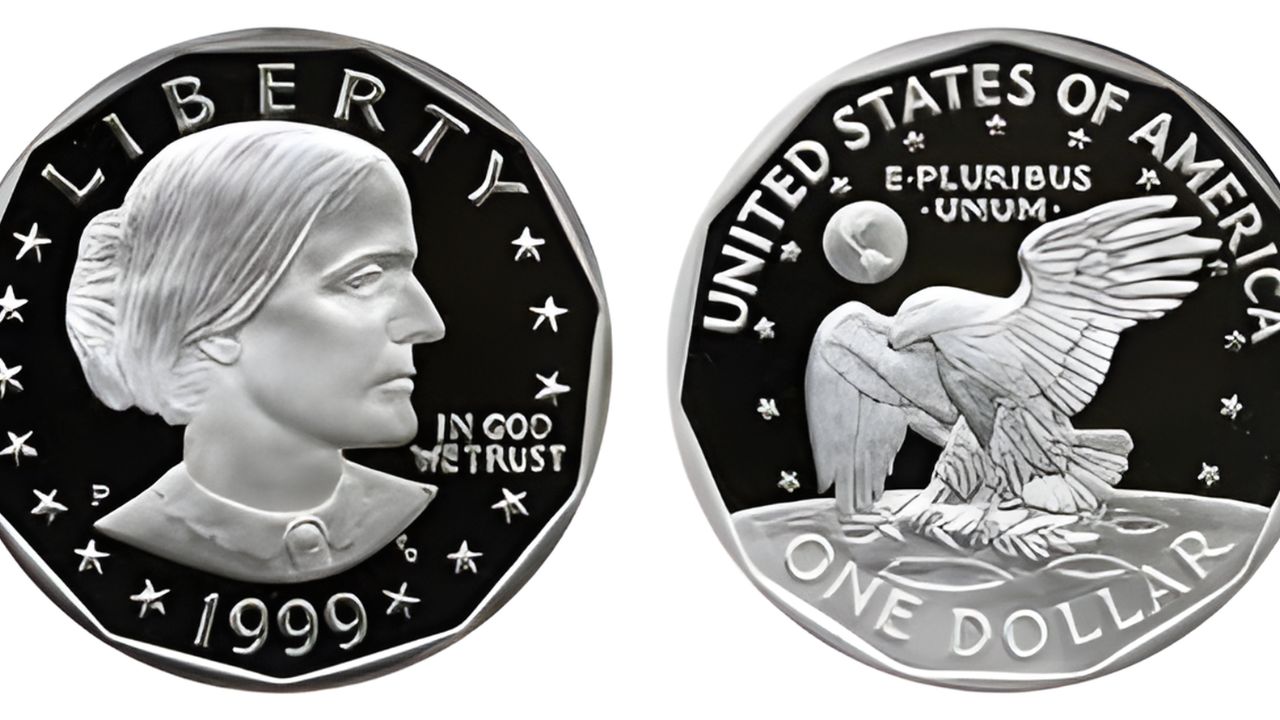
The return of the Susan B. Anthony dollar in 1999 stands as one of the most interesting anomalies in modern U.S. coinage. After an eighteen-year hiatus following the series’ initial cancellation in 1981, the United States Mint was forced to briefly resurrect the “Susie B” to meet a critical demand for dollar coins in vending machines and transit systems before the Sacagawea dollar was ready for release. Today, this unique single-year revival has created a distinct market for collectors. While millions were minted, finding high-grade examples or rare mint errors in 2026 can yield returns significantly higher than their face value.
The Unique History of the 1999 Revival
Unlike the mass-produced runs of 1979 and 1980, the 1999 Susan B. Anthony dollar was a stopgap measure with a much lower mintage compared to its predecessors. The Philadelphia Mint struck approximately 29.5 million of these coins for circulation, making them relatively common in worn condition but far more elusive in pristine Mint State. What makes the 1999-P particularly special for numismatists is its status as a bookend to the series. It connects the vintage clad era of the late 70s with the modern golden dollar era that followed immediately in 2000, creating a bridge that many historical collectors find essential for a complete set.
Current Market Value for Circulated and Mint State Coins
For the average person finding a 1999-P Susan B. Anthony dollar in their change, the news is grounded in reality. Most circulated examples that show signs of wear—scratches, dullness, or loss of detail on Anthony’s hair—are generally worth only their face value of one dollar. However, the market shifts dramatically when dealing with Uncirculated (Mint State) specimens. In 2026, a standard uncirculated coin graded MS63 might fetch between $5 and $8. The real value lies in the higher grades where the “P” mint mark is sharp, and the coin retains its full original luster without bag marks.
High-Grade Gems and the “Condition Rarity” Factor
As of 2026, the premium for top-tier quality has widened. A 1999-P SBA dollar graded MS66 by services like PCGS or NGC typically commands prices in the $30 to $55 range. If you are lucky enough to possess a coin grading MS67, the price jumps significantly, often exceeding $100 to $300 depending on the eye appeal. This price disparity exists because the hard copper-nickel clad composition was notoriously difficult to strike perfectly, leaving many coins with ugly contact marks from the minting process. Finding a “gem” example that survived the bins at the Philadelphia Mint is a true challenge for modern collectors.
The 1999-P Proof Dollar Distinction
One of the most fascinating aspects of this year is the Proof issue. Unlike previous years where Proof coins were struck in San Francisco and bore an “S” mint mark, the 1999 Proof Susan B. Anthony dollar was minted in Philadelphia and carries a “P” mint mark. This makes it the only Proof coin in the entire series to feature the P mint mark. These coins were sold separately or in special sets and feature frosted devices against mirrored fields. In 2026, a flawless PR69 Deep Cameo example is an affordable yet distinct collectible, usually trading between $20 and $40, while a perfect PR70 can command prices upwards of $100.
1999-P Susan B. Anthony Dollar Valuation Table (2026 Estimates)
While the 1999 production run was shorter, it was not immune to quality control issues. Collectors should keep a close watch for major errors which are far more valuable than standard coins. The most sought-after error is the “Struck on Sacagawea Planchet” transition error. Since the Mint was testing the new golden dollar planchets in 1999, a few Susan B. Anthony dies struck these experimental blanks. These are extremely rare and can sell for thousands of dollars. More common but still valuable are off-center strikes and broadstrikes, where the coin was not properly contained by the collar die, resulting in a spread-out, flatter appearance. A nice off-center 1999-P can easily fetch $100 to $300.
Future Market Trends for the Series
Looking ahead, the market for late 20th-century moderns is maturing. As new collectors enter the hobby in 2026, they often start with accessible series like the SBA dollar. This increased demand is slowly drying up the supply of high-grade raw coins, pushing prices up for certified MS66 and MS67 examples. The 1999-P is increasingly viewed as a “key date” not because of low total mintage, but because of its unique position in history and the novelty of its release. We are seeing a trend where collectors are building “high registry” sets, competing for the finest known examples, which drives the top-end prices higher while low-grade coins remain stable.
Conclusion
The 1999-P Susan B. Anthony dollar is more than just pocket change; it is a numismatic encore that offers something for everyone. Whether you are filling a hole in a circulated album or hunting for a pristine MS67 slabbed coin, this year represents a unique moment in U.S. Mint history. For the astute observer, checking specifically for the unique 1999-P Proof or a rare transition error could turn a modest hobby into a profitable discovery. As we move through 2026, preserving these coins in top condition remains the best strategy for realizing their potential future value.

FAQs
Q1 Why does my 1999 Susan B. Anthony dollar look like it has a gold tint?
If your coin has a golden hue, it is likely mostly due to environmental toning or plating added by a third-party company after it left the Mint. However, in extremely rare cases, it could be a transition error struck on a Sacagawea planchet, which would be very valuable and should be authenticated by a professional service.
Q2 Are 1999-P SBA dollars silver?
No, the 1999-P Susan B. Anthony dollar is not made of silver. It is composed of a copper-nickel clad layers bonded to a pure copper core, the same composition used for dimes and quarters. The silver appearance is simply the color of the nickel alloy.
Q3 What is the difference between the 1999-P circulation coin and the Proof coin?
Both coins have the “P” mint mark, which can be confusing. The circulation coin has a standard matte finish and was made for commerce. The Proof coin was specially struck for collectors with polished dies, resulting in a mirror-like background and frosted portrait, and it was originally sold in a protective plastic case.
Disclaimer
The content is intended for informational purposes only. you can check the officially sources our aim is to provide accurate information to all users.